
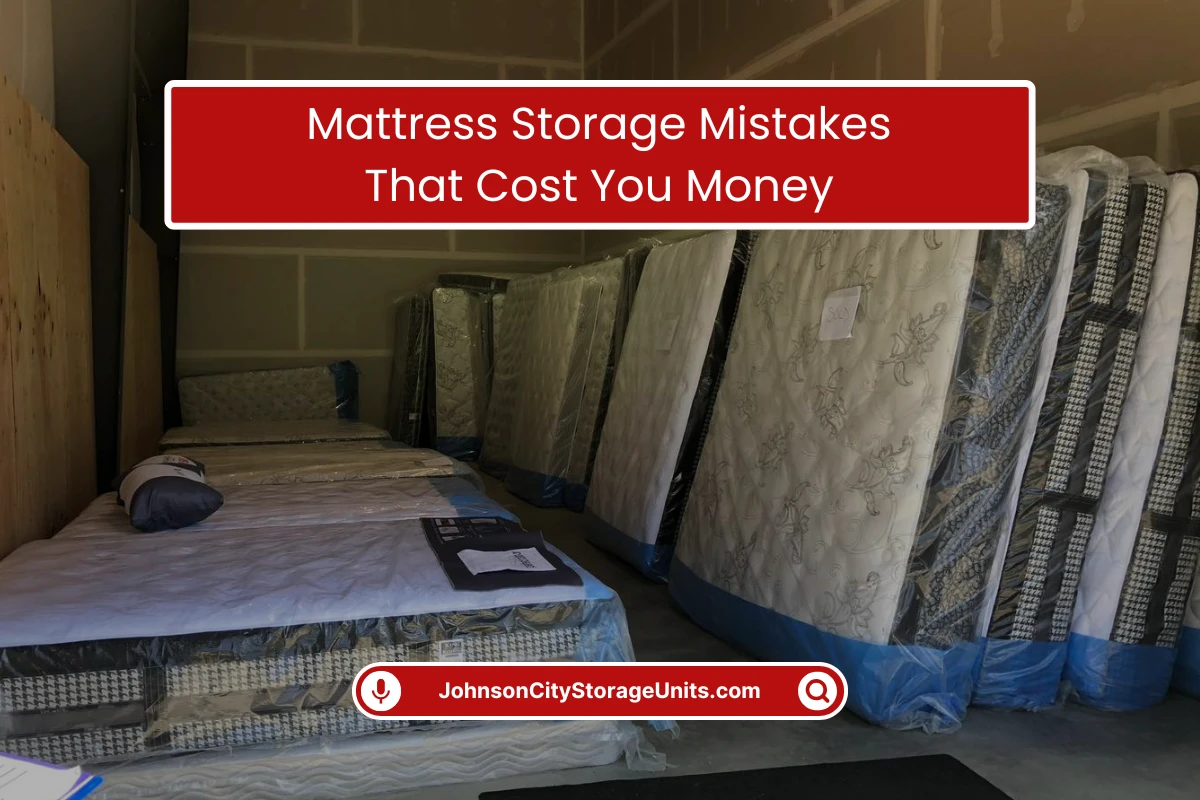
You know what, let’s drop the formal act. I’m just going to talk to you. This isn’t a blog post draft. This is me, a guy who used to work at a storage place, telling you what I saw people do to their mattresses every single week. Grab a coffee. This might get a little ranty.
Alright. You bought a new mattress. The old one’s still okay. Not great, but not trash. So you think, “I’ll just stash it.”
Where?
If you’re like my cousin Dave, you’ll drag it down to the basement. If you’re like my old neighbor Linda, you’ll stand it up in the garage behind the lawnmower. If you’re like me ten years ago, you’ll think a couple of trash bags and some duct tape counts as “protected.”
We were all wrong. And we all paid for it.
A Cautionary Tale: Dave’s Basement Disaster
Let me paint you a picture of Dave’s basement mattress. He called me over two summers ago, his face pale. “You gotta see this.” He’d stored his guest mattress down there for maybe eighteen months. He’d just pulled off the sheet he’d thrown over it. The bottom was covered in a fuzzy, black-and-green map of mold. The smell hit you from three feet away—like wet dirt and regret. Two grand, gone. Because the basement wall it leaned against got damp every spring.
I’m telling you this not to scare you, but because you’d never intentionally ruin something you paid good money for. You just don’t know what you don’t know. So let’s get into it. The big mistakes are stupidly simple.
Mistake 1: The Space-Saving Stand-Up
You think standing it up is smart. It feels smart. It saves floor space! But a mattress is built like a sandwich. All the layers—the pillow top, the foam, the springs—are stacked to handle pressure from above. When you stand it on its side for months, gravity pulls everything sideways. The inside of your mattress slowly slumps, like a sandcastle at high tide. You get a permanent bend. A weird ridge. It’ll never lie flat again. I’ve seen mattresses come out of storage shaped like a parenthesis. That’s your bed.
Mistake 2: The DIY Plastic Trap
This one gets everyone. You see plastic and think, “Barrier.” So you use a painters’ tarp, a mattress bag from the store that’s basically a giant Ziploc, or—God help us—black garbage bags taped together. You’re creating a terrarium. Any tiny bit of moisture in the air when you seal it up is now trapped forever, swirling around inside with your mattress. That’s how you bake mildew. You want the breathable kind of mattress bag. It feels like a heavy-duty fabric bag. Lets it air out just enough without letting the bad stuff in. Go to the moving supplies aisle. It’s the one that doesn’t look like shiny plastic wrap.
Mistake 3: Choosing the Worst Room in the House
Basements sweat. Garages are freezing in winter and become ovens in summer. Attics have wild temperature swings and dust from the dawn of time. Your mattress hates all of these. Heat breaks down foam. Cold makes it brittle. Dampness is an invitation for mold to move in and redecorate. Your mattress wants to live in a boring, climate-controlled room that feels like a hotel hallway. Always 55-75 degrees. Dry air. Boring is good.
Mistake 4: Using It as a Shelf
Once it’s lying flat, it’s so tempting. You start piling boxes of books, old records, that heavy toolkit on it. Each box creates a tiny, permanent crater. Those pressure points don’t bounce back after a year. Imagine sleeping on a mattress that has the ghost of a toolbox imprinted in it. Not great.
The Right Way: A Boring, Foolproof Plan
So what’s the right way? It’s boring, but it works.
- Step 1: Clean it. Seriously, vacuum it. Crumbs attract bugs. Stains can set.
- Step 2: Bag it right. Get the breathable bag. Zip it.
- Step 3: Lay it flat. On the floor is okay if it’s dry, but put a pallet or even an old rug under it first.
- Step 4: Pick a sane location. If your house doesn’t have a perfectly dry, temperate space (most don’t), that’s the whole point of specialized storage. This isn’t a sales pitch, it’s physics. At our place, for example, we don’t just lock a door. We fight the weather so you don’t have to. Our units are bone-dry and temperature-stable year-round, specifically so stuff like mattresses, photo albums, and grandma’s chair don’t get wrecked by a humid Tuesday. You provide the bag, we provide the perfect boring closet.
- Step 5: Visit it. Don’t just forget it. Every few months, pop your head in. Make sure the bag is intact. Sniff the air. Five minutes of checking saves a thousand bucks of heartache.
Stop Wrecking Your Stuff
It really is that simple. The difference between a mattress that’s “ruined” and one that’s “perfectly good” isn’t magic. It’s just avoiding a few dumb, easy-to-make choices.
Do it right. Spend the thirty bucks on the right bag. Find a truly dry, flat space. Then, in a few years, when you need a spare bed, you’ll unzip it and it’ll just be… a mattress. Not a science project. Not a piece of modern art. Just a bed. And you’ll feel like a genius.











0 Comments